Stop repeating the same architecture review on AI-generated PRs.
Turn recurring architecture review comments into deterministic PR checks before they reach human review.
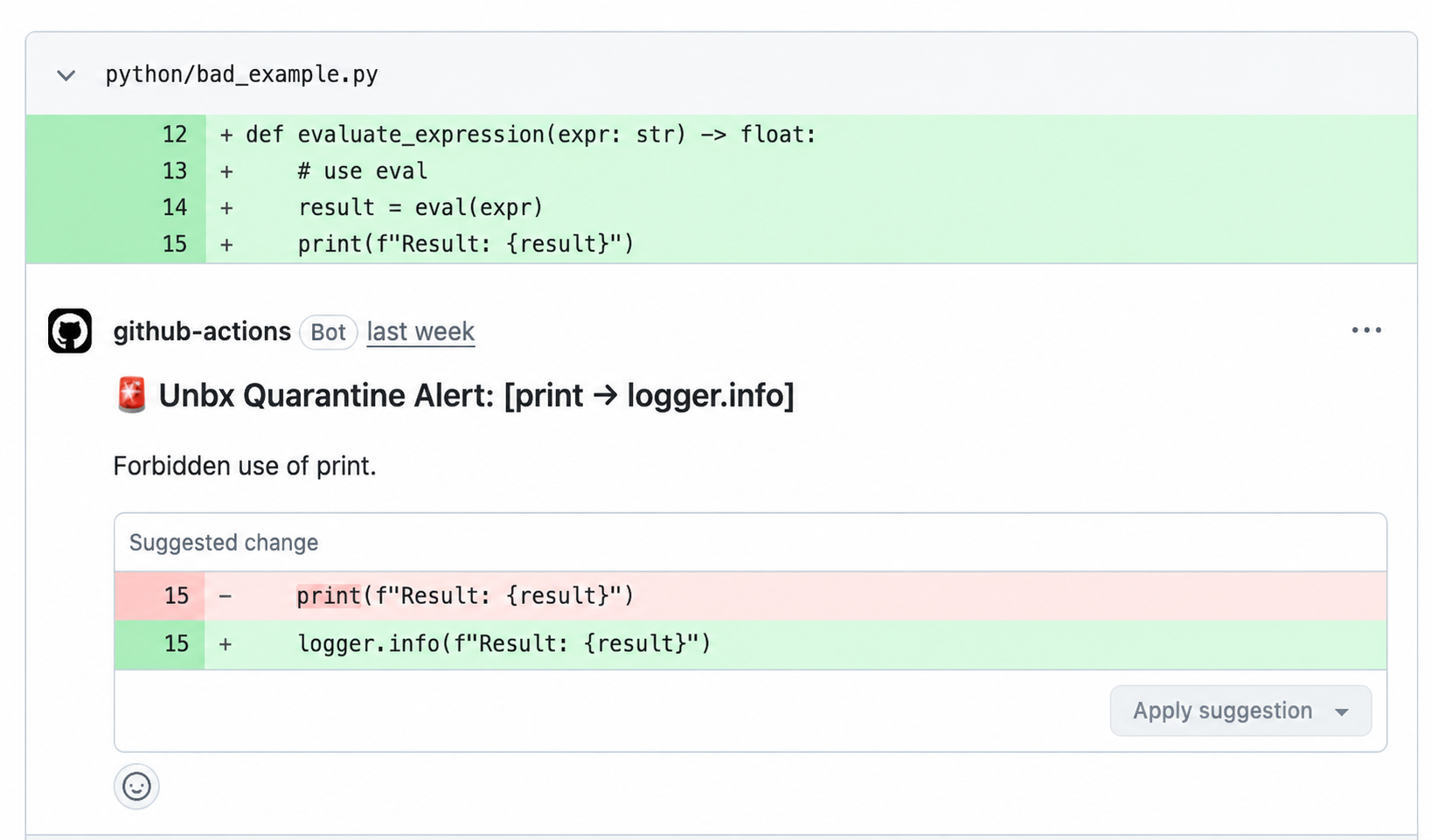
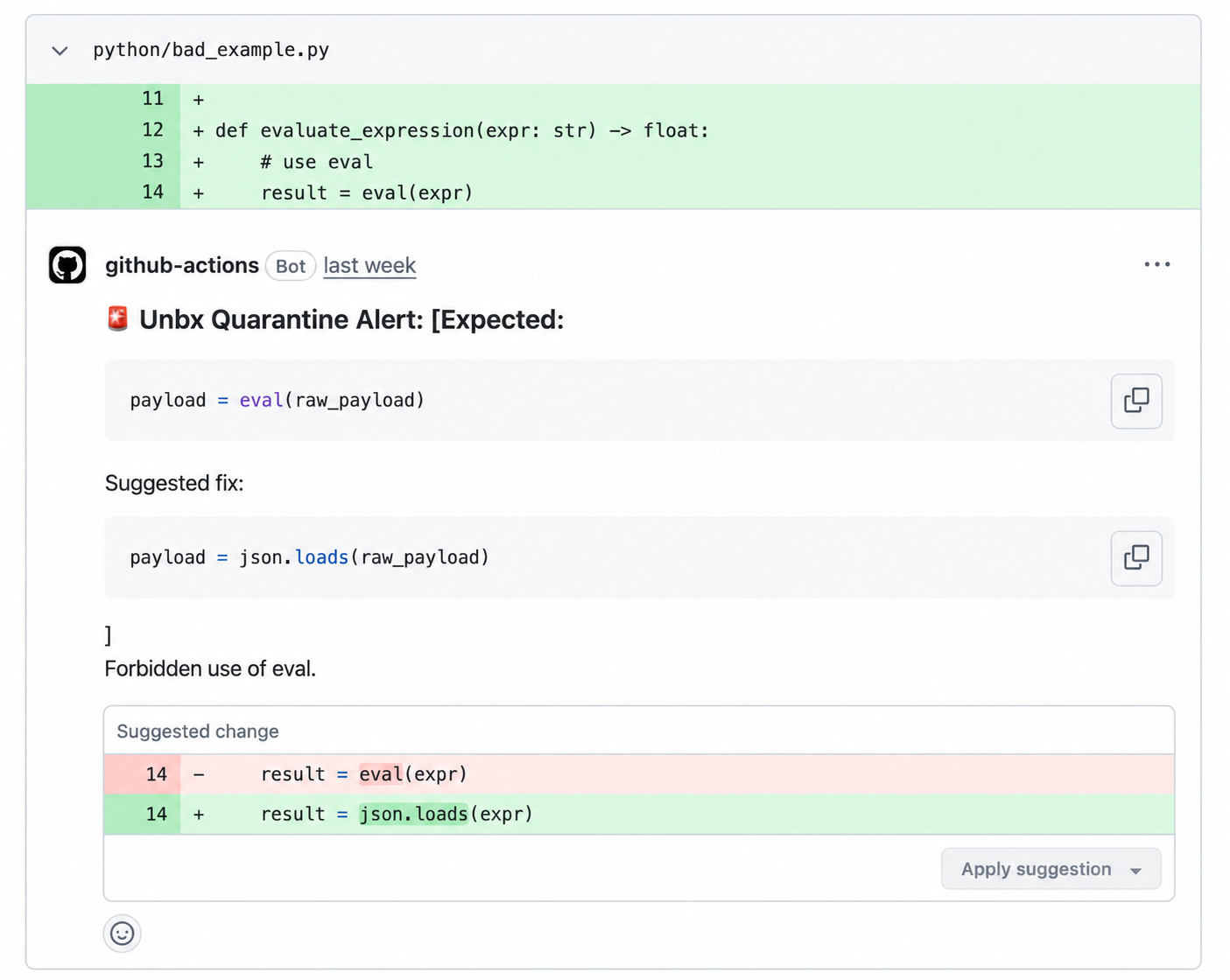
We are currently onboarding a small number of companies to validate Unbx on real repositories.
Define
Describe the architectural decision your team already repeats in review.
Detect
Unbx validates the rule and scans the repository for structural violations.
Enforce
Surface violations in the development workflow before they become repeated review work.
Your team has already written the rules. They are trapped in review comments.
AI coding makes implementation faster, but written guidelines remain advisory. Senior engineers repeatedly reconstruct the same architectural context during review.
Unbx turns the repeatable part of that context into enforceable rules.
From engineering intent to enforceable checks.
Describe the rule
Enter a natural-language engineering constraint.
Validate the rule
Unbx converts it into a structured rule specification and reports its support level.
Scan and enforce
The rule is applied to repository changes through Unbx, CI, or pull-request checks.
Rules for every layer of your architecture.
Keep dependencies and responsibilities inside the boundaries your system expects.
Linters know syntax. Unbx enforces your architecture.
| Capability | Linters | Semgrep | AI review | Human review | Unbx |
|---|---|---|---|---|---|
| Style and syntax rules | Strong | Strong | Variable | Strong | Supported |
| Known code patterns | Limited | Strong | Variable | Strong | Strong |
| Organization-specific architecture | Weak | Manual | Non-deterministic | Strong | Core capability |
| Natural-language rule input | No | No | Yes | Yes | Yes |
| Deterministic repeatable checks | Yes | Yes | No | No | Yes |
| Explain support limitations | Limited | Technical | Variable | Yes | Required |
A generated rule is not trusted until it is verified.
Before a rule is used, Unbx validates its structure and tests whether it detects the intended pattern. The interface exposes validation status, supported scope, and scan integrity instead of hiding uncertainty behind an AI response.
Enforce rules where code already changes.
Unbx runs on pull requests automatically. Changed files are scanned against your active rules and violations are surfaced before the code reaches review.
Built for engineering teams that need to understand the result.
Deterministic scanning
Rule checks are structural, not probabilistic. The same input produces the same result.
Limited AI responsibility
AI is used for rule input and suggestions only. Detection logic is deterministic.
Explicit support status
Detectable, partially detectable, and unsupported rules are always clearly labeled.
Least-privilege GitHub access
Unbx requests only the permissions required to read changed files and post check results.
Transparent scan integrity
Every rule shows its validation result. Uncertainty is surfaced, not hidden.
Data handling controls
Customer code is not used for model training. Data retention policy is documented.
Help shape architecture enforcement for AI-native teams.
What you get
- Early access to Unbx
- Direct support for rule definition
- Priority influence on supported rules and languages
- A structured pilot around a real repository
What we ask for
- An active software repository
- Regular use of AI coding tools
- A recurring architecture or review problem
- Periodic feedback during the pilot
Best suited for 2–20 person engineering teams using AI coding tools in production development.
We review applications personally and prioritize teams with active repositories, recurring architecture review issues, and regular use of AI coding tools.
FAQ
- Linters detect style, syntax, and known code patterns through predefined rules. Unbx enforces organization-specific architectural decisions that linters cannot express — such as which modules may import from which layers, or which patterns are prohibited in your specific codebase.
- Semgrep requires manually writing pattern rules in its own syntax. Unbx accepts natural-language rule descriptions, converts them into structured checks, and reports whether the rule can be detected before applying it. Unbx is focused on team-specific architectural intent rather than generic security patterns.
- No. LLM assistance is used to interpret natural-language rule input and generate rule specifications. The actual code scanning is deterministic. The same rule applied to the same code always produces the same result.
- No. Unbx validates each rule and reports whether it is detectable, partially detectable, or unsupported before applying it. Rules that depend on runtime behavior, business semantics, or context that cannot be determined structurally will be marked as unsupported.
- Unbx reports the rule as unsupported and explains why. It will not apply a rule that cannot be reliably detected. You can modify the rule, narrow its scope, or leave it as a documented guideline outside Unbx.
- No. Unbx detects violations and surfaces suggested directions. It does not apply automatic code changes. Fix availability varies by rule and is clearly labeled in the interface.
- TypeScript, Python, and Go are supported in the current MVP. Additional languages are planned based on design partner feedback.
- Unbx requests read access to repository contents and permission to write check results on pull requests. It does not request write access to code or the ability to merge or close pull requests.
- Unbx is in design partner validation. It is functional on real repositories but is not yet a general-availability product. Design partners work directly with the team during a structured pilot.
- Design partners connect a real repository, define rules for their recurring architectural problems, and use Unbx during active development. The team provides direct support throughout. Partners give structured feedback in exchange for early access and direct influence on the product roadmap.
Stop repeating the same architecture review.
Join a limited pilot with direct onboarding from the founding team and validate Unbx on a real repository.
"Move this logic out of the controller."
"Do not call the database from this layer."
"Use the project logger instead of print."
"Follow the existing repository pattern."